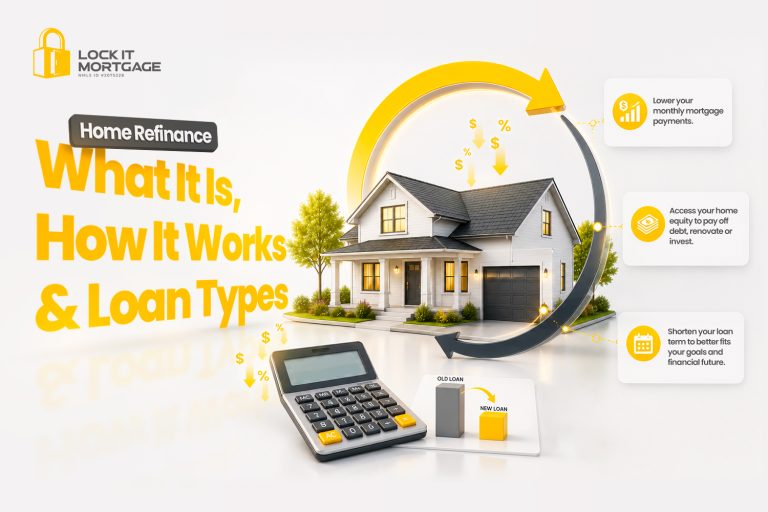



If you need to fund a home renovation, pay off high-interest debts, or cover major expenses, your home’s equity is often the most cost-effective tool available. A cash-out refinance allows you to access that built-up value, but before you move forward, you need to understand how the process works, what it takes to qualify, and how to protect your hard-earned wealth.
This guide breaks down the qualifying guidelines and explains the step-by-step process while comparing your options to home equity loans. These insights ensure you choose the perfect financial path for your budget.
Key Takeaways
- Learn how a cash-out refinance lets you access your home equity.
- Understand the current market conditions shaping mortgage rates and approval rules.
- Evaluate the pros and cons of this strategy and look at alternative ways to borrow against your home.
What is a cash-out refinance and how does it work?
A cash-out refinance is a mortgage option where you replace your current home loan with a completely new, larger mortgage. Your new loan pays off your original mortgage balance in full, and the remaining amount, minus standard closing costs, is given directly to you as a lump sum of cash.
Homeowners commonly use a cash-out refinance to access money for major financial goals, including:
- Major expenses: Funding education tuition costs, handling unexpected medical bills, or injecting business capital.
- Home improvements: Remodeling kitchens, replacing a roof, or adding square footage to directly increase the home’s market value.
- High-interest debt consolidation: Paying off credit cards or personal loans to combine multiple expensive debts into a single, lower interest rate mortgage payment.
- Real estate investments: Pulling out equity to use as a down payment on a new primary residence or a rental property to generate passive income.

A cash-out refinance allows you to fund home improvements, consolidate high-interest debt and finance a major investment.
How much can you borrow with a cash-out refinance?
Lenders calculate how much money you can take out by looking at your home’s current value, what you still owe on your mortgage, and the 80% Loan-to-Value (LTV) rule. Most lenders require you to leave at least 20% of your home’s value untouched.
Here is an example of how the numbers work if your home is worth $450,000:
- Current home value: $450,000
- Remaining mortgage balance: $250,000
- Maximum loan limit (80% of home value): $450,000 x 0.80 = $360,000
- Cash available to borrow (before closing costs): $360,000 (new loan) – $250,000 (old loan payoff) = $110,000
What are the requirements for a cash-out refinance?
Because a cash-out refinance increases your overall debt, lenders look closely at your financial profile to ensure you can comfortably handle the new mortgage. Here are the basic requirements you must meet to qualify:
- Credit score: Most lenders require a minimum score of 620. To secure the best possible mortgage rates, a score of 700 or higher is recommended.
- Loan-to-value Ratio (LTV): You’ll generally be able to borrow up to 80% of your home’s total value, meaning you must leave 20% equity in your property after the loan closes.
- Debt-to-income Ratio (DTI): This is the percentage of your monthly income used to pay recurring debts. Lenders prefer a DTI of 43% or less, though some guidelines allow up to 50% for well-qualified applicants with strong savings.
- Home equity: You must have enough built-up equity to borrow against while maintaining the minimum 15-20% equity required by most lenders.
- Income & employment verification: Lenders need to confirm you can afford your new payments.
- Regular W-2 employees can easily prove steady income using recent pay stubs, W-2 forms, or basic tax returns.
- If you are self-employed, a freelancer, or a real estate investor, specialized cash-out programs are built just for you, letting you qualify using alternative documents like 12 to 24 months of bank statements, or the rental income generated by the property itself,… instead of standard tax forms.
- Property condition & Home appraisal : Lenders require a professional home appraisal to look at the property as a whole. The appraiser will check the home to make sure it is safe, structurally sound, and meets basic lending standards. At the same time, they figure out your home’s actual current market value.
- Waiting period: If you recently purchased your home, you must typically meet specific lender seasoning requirements before cash-out refinance. Conventional and FHA loans both require a minimum waiting period of 12 months, while VA loans permit refinancing after a shorter duration of 210 days.
💡 Lock It Mortgage Tip: Lower credit score? Don’t worry if your credit profile isn’t perfect. Lock It Mortgage works with a wide range of credit profiles and can guide you through the necessary steps to improve your credit standing and better position yourself for the best available market rates.
How home appraisal can affect the cash-out refinance
Because your borrowing power is directly tied to your property’s value, the final appraisal report heavily dictates the terms of your cash-out loan.

How home appraisal values affect equity and maximum cash-out refinance loan limits.
- High appraised value: If your home appraises for more than you expected, it is great news. A higher valuation means you have more equity to work with. This makes it easy to get the exact amount of cash you need while keeping your total loan amount well under the 80% rule. Because there is less risk for the lender, a high appraisal can help you unlock lower interest rate options or allow you to borrow more cash if your financial goals change.
- Low appraised value: If your home appraises lower than you thought, or if the appraiser finds serious damage that needs fixing, your loan will hit a snag. Because banks strictly limit your loan to 80% of the true appraised value, a lower value cuts down your maximum loan size. This leaves you with two options:
- Walk away with a smaller cash check than you planned, or bring your own cash to closing to make up the difference.
- In worst-case scenarios where your home is worth less than what you currently owe on your mortgage, the lender will deny your application completely.
How do home equity loan limits change by property type?
Because different property types represent varying levels of risk for mortgage lenders, qualification guidelines and borrowing limits differ significantly depending on how you use the home.

Home equity loan limits and lender requirements vary significantly for primary residences, second homes, and investment properties.
1. Primary residences
Tapping equity in the home you live in full-time offers the easiest qualification rules and the lowest available interest rates.
- Maximum borrowing limits: You can typically borrow up to 80% to 85% of your home’s total value. Select lenders or specialized programs, like VA cash-out refinances, may allow qualified borrowers to tap up to 95% or even 100% equity.
- Lender requirements: Lenders look for standard credit scores, usually starting at 620, and a normal history of steady monthly income and manageable debts.
2. Second homes & Vacation homes
The rules get tighter for properties like vacation homes. Banks view these loans as higher risk because if a homeowner faces sudden financial trouble, they always prioritize paying the mortgage on their main house first.
- Maximum borrowing limits: Most lenders require you to leave at least 20% to 25% equity untouched in the property, capping your total borrowing limit at 75% to 80% of the home’s value.
- Lender requirements: You will likely need a higher credit score to get approved. Lenders will also carefully check your paperwork to confirm you use the property strictly for personal vacations and do not use it as a full-time rental.
3. Investment & Rental properties
Taking cash out of an investment property requires passing the strictest review process. Lenders are cautious here due to the risks of tenant vacancies and changing rental markets.
- Maximum borrowing limits: You are generally required to leave a larger equity cushion of 25% to 30% untouched in the house, capping your borrowing limit at 70% to 75% of the total value.
- Lender requirements: Borrowers generally need excellent credit scores of 720 or higher. You must also prove you have an emergency fund with 6 to 12 months’ worth of mortgage payments sitting safely in your bank account to cover times when the property is empty.
How does the cash-out refinance process work?
Getting a cash-out refinance is very similar to your first mortgage. Here is what to expect from start to finish:

6 steps of the cash-out refinance process from calculation to receiving funds.
Step 1: Figure out your numbers: Check how much cash you actually need and make sure you have enough built-up value to leave at least 20% equity in your home.
Step 2: Shop around and apply: Compare offers from a few different lenders or a broker. They will check your credit score, income, and bills to give you a quote on your new interest rate.
Step 3: Get an appraisal and loan approval: Once you pick a lender, they will review your paperwork and order a home appraisal to check your home’s current condition and confirm its true market value.
Step 4: Pay off the old mortgage: On closing day, your new, larger loan automatically pays off your original home loan in full.
Step 5: Get your cash: After your old loan and closing fees are paid, our cash proceeds are sent directly to your bank account as a lump sum.
Step 6: Start making your new payments: You will begin making a single monthly payment on your brand-new loan schedule, choosing a timeline like a fresh 15-year or 30-year payoff track.
Keep in mind: Signing up for a new 30-year loan is a double-edged sword. While stretching your payments out over a longer timeline can lower your immediate monthly bills, adding all those extra years means you will typically end up paying a lot more in total interest over the life of the loan.
How do you get the most competitive cash-out refinance deal?
Shop around: Don’t settle for the first offer. It pays to compare rates, fees, and terms from at least 3 to 5 different lenders, including banks, credit unions, and independent mortgage brokers, to secure a truly competitive deal.
Understand all costs: Look beyond the initial interest rate. Always factor in closing costs like appraisal, title, and origination fees, which typically range from 2% to 5% of your new loan amount. Calculate your break-even point to make sure the refinance makes sense.
Borrow only what you need: It can be tempting to take the maximum available equity, but only borrow what you can comfortably repay and genuinely need to keep your monthly payments manageable.
Lock your rate: Once you find a favorable rate that fits your budget, ask about locking it in to protect your monthly payment from sudden market changes during processing.

Tips for getting the most competitive cash-out refinance rate and deal.
Compare today's refinance rates





LOAN LIMITS
SEND US YOUR QUESTION(S)
SHARE THIS RATE QUOTE
OUR LOAN OFFICERS ARE HERE TO HELP!
Fill out the form below, and we'll be in touch shortly.
VA FUNDING FEE RATES
VA IRRRL FUNDING FEE RATES
PROPOSED Housing EXPENSE
RATE ALERT SETUP
What is the difference between a cash-out and a rate-and-term refinance?
The most straightforward option is a rate-and-term refinance. No money changes hands in this case, except for the standard fees associated with the loan. The size of your mortgage remains the same; you simply trade your current mortgage terms for newer, better terms.
In contrast, with a cash-out refinance loan, the new mortgage is bigger than the old one. Along with completely new loan terms, you’re advanced cash from your home’s equity.
| Feature | Cash-out refinance | Rate-and-term refinance |
| Purpose | Access cash and adjust loan terms | Only adjust loan terms (rate/term) |
| Equity handling | Withdraws cash from home equity | No cash taken |
| Mortgage size | Increases (old loan balance plus cash-out) | Stays the same |
| Credit score requirements | Higher due to increased risk profile | More flexible |
| Interest rate | Slightly higher | Typically lower |
What are the best alternatives to a cash-out refinance?
If your existing first mortgage carries an incredibly low interest rate, replacing it entirely with a cash-out refinance may not be your best financial move. Consider these other ways to use your equity:
Comparing your equity options
| Feature | Cash-out refinance | Home equity loan (HELOAN) | HELOC |
| How it works | Replaces your first mortgage entirely with a larger loan. | A separate, second mortgage providing a fixed lump sum. | A revolving, variable-rate line of credit using your home as a credit card. |
| Payment structure | One simple monthly mortgage payment. | Two separate monthly payments consisting of your First Mortgage and Second Mortgage. | Flexible monthly payments based only on the amount you draw. |
| Best used for | Large lump sums, debt consolidation, or long-term structural changes. | Homeowners with a low primary rate who have a single, fixed expense. | Multi-phase projects where you need to pull and repay cash repeatedly over time. |
What about Personal Loans? If you only need a small amount of cash under $15,000 for a short-term emergency, a Personal Loan may be a safer alternative. They do not require using your home as collateral, meaning your property is never at risk, though they do carry significantly higher interest rates.
Reverse mortgage for homeowners aged 62 and older: Allows older homeowners to convert home equity into cash or a line of credit without monthly mortgage payments. The loan is simply repaid later when the home is sold or the borrower moves out.
What are the pros and cons of a cash-out refinance?
✅ Pros of a cash-out refinance:
- Access to big sums of cash: You can unlock a significant amount of money all at once, usually at an interest rate that is much cheaper than a credit card or personal loan.
- Potentially lower interest rates: Mortgage rates are traditionally lower than credit cards or personal loans. Plus, if market rates have dropped since you got your first mortgage, you could score a lower rate on your entire new loan balance.
- Easy debt consolidation: You can pay off multiple high-interest debts and combine them into one single monthly mortgage payment with a lower rate.
- One simple monthly bill: You still only have one mortgage bill to track every month, rather than managing a separate first and second mortgage.
- Possible tax deductions: If you spend your cash proceeds specifically on major home renovations, your mortgage interest might be tax-deductible. Check with a tax advisor to find out if you qualify.
❌ Cons of a cash-out refinance:
- More debt on your home: You are increasing your total mortgage balance, which means you owe more on your home and will have less remaining equity.
- Upfront closing fees: You will need to pay standard closing costs (usually 2% to 5% of the new loan amount). Rolling these into your loan keeps you from paying out of pocket, but it adds to your overall debt.
- Appraisal and home condition risks: If the appraiser finds serious code or safety issues, or values your home lower than you expected, your borrowing limit will drop. This can lower your final payout, require costly fixes, or cause the bank to deny your application completely.
- Risk of losing your home: Because your home is used as collateral, missing payments on a larger loan puts you at risk of foreclosure.
- Restarting your payoff clock: If you move into a fresh 30-year mortgage, you reset the timer on your home debt, which can mean paying more total interest over the life of the loan.
- Higher rates than standard refinancing: Banks charge slightly higher interest rates for a cash-out loan than they do for a basic rate-and-term refinance where no money changes hands.
- Risk of needing monthly mortgage insurance: If your home equity drops below 20% during a refinance, you might be required to pay for private mortgage insurance (PMI). While this is rare because cash-out loans are typically capped at 80% LTV, certain government programs (like FHA loans) require monthly mortgage insurance regardless of how much equity you leave in the home.
Is a cash-out refinance right for you?
A cash-out refinance is a great strategy if you have a clear financial plan. Since it completely replaces your current home loan with a larger balance, it requires a careful look at your budget.
Take a moment to review your monthly income, figure out the exact amount of cash you need, and make sure the new monthly payment sits comfortably in your wheelhouse. If you are using the money to knock out expensive credit card debt, add real value to your property through renovations, or fund an investment property, this move can be an absolute win for your long-term wealth.
Why choose Lock It Mortgage for your loan?
At Lock It Mortgage, we put your loan first. We cut through the corporate red tape to bring you exactly what you need: highly competitive mortgage rates, swift response times, and the flexibility to close your deal on time.

Your mortgage, our priority.
- We look for alternate paths to ‘Yes’: If a traditional bank turned you down because of self-employment income, a complex tax profile, or a unique financial background, we don’t just throw away your file. We specialize in finding alternative underwriting solutions to get you approved.
- The wholesale rate advantage: As a mortgage broker, we don’t just offer one set of rates. We shop your loan across the nation’s top 40 lenders to secure the most competitive interest rates and low fee setups.
- We value your time: You shouldn’t have to wait months to access your own home equity. Our streamlined digital loan process ensures fast response times and quick answers, saving you from endless back-and-forth phone calls.
- Straightforward transparency: We believe in complete honesty from day one. We give you a clear, upfront breakdown of your new loan terms, estimated payments, and closing fees so you can make your final choice with total confidence.
Let’s build a plan for your equity
Every home and every budget is completely unique. If you’re ready to see how a cash-out refinance would look on your exact property, our team is here to run the numbers with you. We’ll help you look at your home’s estimated value, analyze your potential new monthly savings, and find the specific loan options that match your immediate cash needs without overstretching your budget.
Call us: 888-870-5625
Email us: info@lockitmtg.com