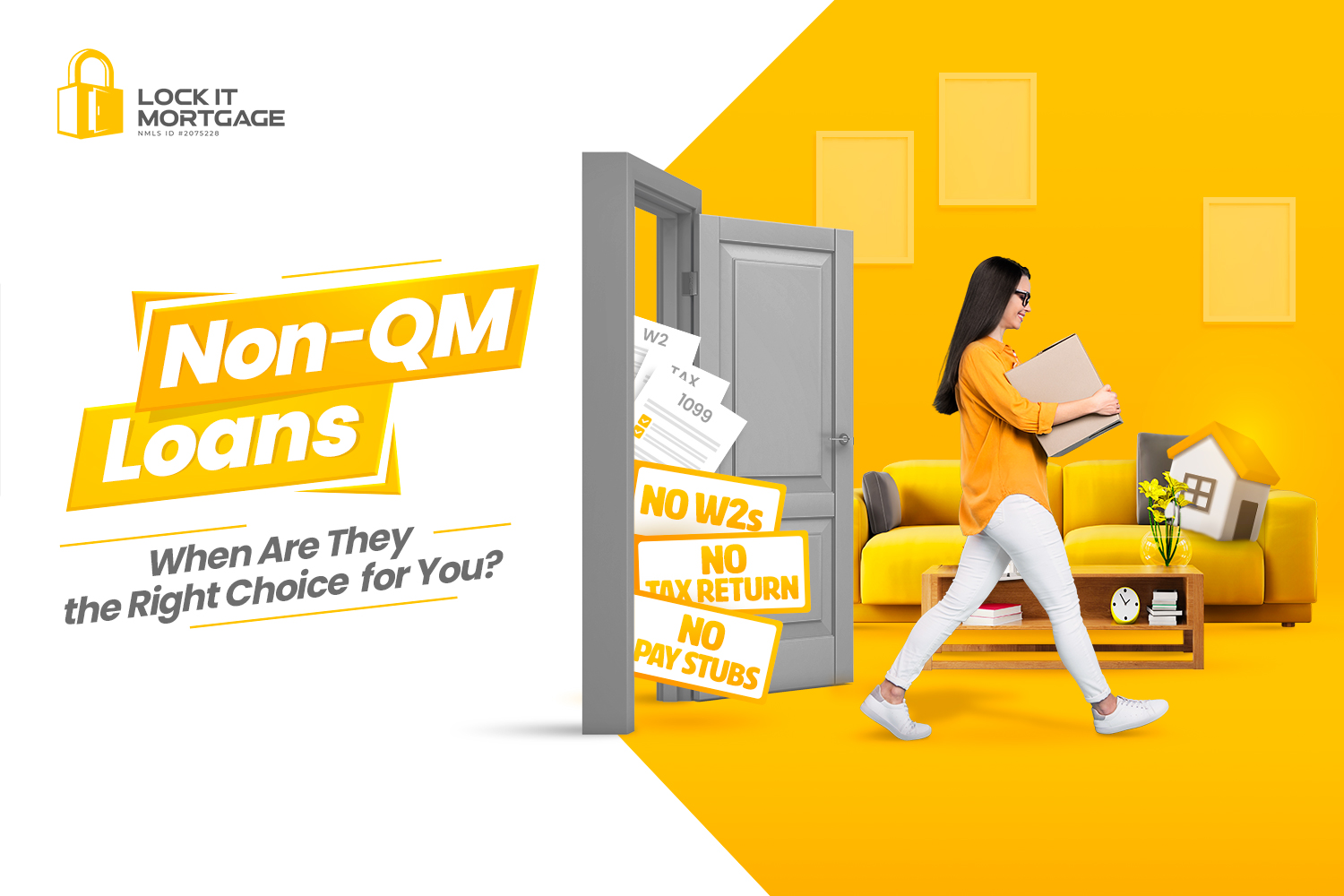


What is a Non-QM loan?
Qualifying for a mortgage can be a massive headache, especially if your income is hard to document or calculate. A non-qualified mortgage (non-QM loan), also known as an alternative income documentation loan, offers flexible requirements that make home financing possible for borrowers with unique financial situations.
Whether you want to buy a new home or refinance your current mortgage, a non-QM loan could be the perfect solution. Instead of just looking at standard paperwork like W-2s, paystubs, or tax returns, a non-QM loan looks at your actual financial health to find a clear path to approval.
💡 The Reality: Non-QM Loans are safe & secure
It’s important to clear the air: Non-QM loans are not risky, subprime, or lower-quality options. They are safe, secure home loans that are simply built differently to help people who don’t fit into everyday lending boxes. Instead of following strict, one-size-fits-all rules, these programs give independent contractors, freelancers, and business owners the freedom to qualify using alternative financial proof.
What’s a non-QM loan?
Qualified vs. Non-Qualified Mortgages: What’s the difference?
The core difference between qualified and non-qualified mortgages comes down to consumer protections put in place by federal regulators, including the Consumer Financial Protection Bureau (CFPB). These rules govern the interest rates, fees, and safety standards of home loans. Most importantly, they require lenders to confirm that a borrower can actually afford their loan before approving it.
Traditional Qualified Mortgages (QM) use standard rules that rely heavily on W-2 forms, paystubs, and tax returns to prove your income. Non-QM loans operate under a different, more adaptable framework. Instead of relying on corporate employee documentation, these programs allow lenders to evaluate your financial situation through alternative paperwork, verifying your ability to pay by looking at your broader financial health and real cash flow.
Look at how these guidelines compare side-by-side:
| Loan Feature | Conventional Loans (Qualified Mortgages) | Non-QM Loans (Non-Qualified Mortgages) |
| Proof of Income | Standard tax returns, W-2s, and paystubs | Alternative documentation (Bank statements, WVOE, or P&L statements) |
| Loan Rules | Fixed conventional guidelines and uniform checks | Flexible requirements tailored to your specific income setup |
| Debt Limit (DTI) | Approvals usually cap around 43% to 45% | Increased flexibility (up to 50% depending on the specific program) |
| Credit score | No minimum score (620+ preferred) | Minimum score of 660 required (680+ preferred). |
| Down Payment | As low as 3% to 5% (or 0% depending on the program) | Typically ranges from 10% to 25% (Larger down payments can secure better interest rates) |
⚠️ Important: A non-QM loan is NOT a “No-Doc” Mortgage
Don’t mistake a non-QM loan for a “no-doc” or “no-income-check” loan. Lenders do not just take your word for it. Federal laws require banks to verify your Ability to Repay (ATR) to protect everyone involved. Lenders still verify your numbers to make sure you can comfortably afford your monthly payments. Instead of forcing you to meet standard guidelines, they simply review customized financial proof that accurately reflects your actual income and financial stability.
Who should consider a non-QM loan?
Non-QM loans offer flexible guidelines that look at the whole picture, giving you a much higher chance of mortgage approval. You will benefit from these programs if you fall into any of these scenarios:
- Self-Employed, Freelancers, or 1099 Contractors: If your tax returns show heavy business write-offs that make your income look lower than it actually is, these programs are a lifesaver.
- Using side income: If you have a primary job but want to use your extra gig-work or side-income to qualify for a larger loan amount, standard programs usually ignore it. Non-QM embraces it.
- High assets, limited income: If you have recently retired, sold a business, or built up a substantial portfolio of savings and investments, your financial strength lives on your balance sheet rather than a traditional weekly paystub. These programs allow lenders to evaluate your verified liquid assets as a core component of your repayment capacity.
- Real estate investors: Qualify based on the property’s expected rental income rather than your personal income, allowing you to easily scale your portfolio.
- Bouncing back from a credit event: If you had a past financial hiccup like a bankruptcy or foreclosure but you are fully recovered, stable, and back on track, you don’t have to wait years for the traditional bank penalties to expire.
- High debt-to-income (DTI) with a solid plan: If your monthly bills push you past the standard bank limits, but you have a secure strategy and plenty of cash reserves to manage your obligations, these rules are much more forgiving.
- Complex pay structures: If you make your living through heavy commissions, business partnerships, or unique corporate payout structures, automated bank systems often get confused and reject the file. Non-QM looks at how you actually get paid.

Flexible qualification criteria and eligible borrower profiles for Non-QM loans.
Your options: What types of non-QM loans can you choose from?
Depending on how you earn and manage your money, you can choose from several different alternative documentation paths:
- Bank statement loans (12 or 24 Months): Lenders skip your tax returns entirely. Instead, they look at your personal or business bank statements over a one- to two-year period, add up your real deposits, and average them out to find your qualifying income.
- Profit & Loss (P&L) only loans: If you don’t want to hand over pages of bank statements, you can qualify using an up-to-date financial statement for your business that is certified by a licensed CPA or tax professional.
- Written verification of employment (WVOE) loans: Built for standard employees who have complex pay setups, like heavy commission splits, variable bonuses, or corporate perks, that don’t show up clearly on regular paystubs. The lender simply verifies your earnings via a direct form from your employer.
- DSCR investor loans: Designed strictly for rental properties. Lenders calculate your eligibility using the Debt Service Coverage Ratio (DSCR), meaning they care about the property’s rental cash flow, not your personal job history.
- Asset-based / Asset utilization loans: Designed for individuals with significant liquid savings, brokerage accounts, or retirement funds. Instead of tracking traditional employment revenue, the lender uses a regulated mathematical formula to factor a portion of your verified asset balances into the qualification process to establish your overall ability to repay.
- Recent credit event loans: A specialized path for buyers who are temporarily locked out of traditional mortgages due to a recent housing glitch, short sale, or credit setback.
- Foreign national & ITIN specialties: Programs that leverage international credit profiles, foreign asset statements, or alternative verification methods for non-U.S. buyers and ITIN holders.
- Non-traditional Jumbo loans: If you are buying a high-end luxury property that exceeds standard conventional baseline limits ($832,750 for single-family homes), you can secure a massive loan amount using alternative documentation.

Non-QM mortgages offer alternative documentation options and flexible program types.
Eligibility criteria: What does it take to qualify? (The 5 core pillars)
Because every non-QM loan is customized to your unique scenario, the rules can vary. However, lenders will always evaluate your application based on these five main factors:
- Credit score: Credit guidelines are highly accommodating here, but your score still dictates your interest rate. The higher your score, the lower your monthly payment will be.
- Down payment: Because alternative paperwork carries more baseline risk for a lender, you will generally need to put down between 10% and 25%. If you can put down 20% or more, it opens up a massive variety of program choices and locks in the best rates.
- Income proof: You prove your ability to handle the mortgage using your choice of alternative records, whether that means pulling business bank statements or providing a verified P&L sheet.
- Debt-to-income (DTI) ratio: You still need to show a safe financial balance. While traditional loans put a hard stop on your debt load, Non-QM programs easily give approvals for DTI ratios up to 50% or more.
- Stability history: You don’t need to show a flawless two-year stint in the exact same corporate job. Lenders just want to see that your current business, freelance work, or income stream is stable, reliable, and likely to continue.

Five key requirements lenders check to approve a non-QM home loan.
The pros and cons of a non-QM loan: What’s the catch?
Before you sign on the dotted line, it is important to weigh the massive benefits against the real trade-offs:
The Pros
- Eliminates complex document demands: It removes the need for the dense, multi-year financial history required by traditional mortgages, especially for self-employed individuals, gig workers, and business owners whose true earnings don’t fit onto a standard tax return.
- Protects your tax write-offs: You can maximize your legal business deductions on your tax returns without worrying about lowering your qualifying income for a mortgage.
- Grow your portfolio faster: Real estate investors can bypass standard bank caps on how many properties they can finance at one time.
- Flexible refinance opportunities: Non-QM guidelines apply equally to both purchases and refinances. If you close using an alternative documentation structure now, you can use those same programs later to lower your rate if market conditions improve.
- Boosts your real buying power: Traditional mortgages rely strictly on net numbers that can artificially shrink how much a bank says you can borrow. Non-QM programs look at your actual gross cash flow, reflecting your true purchasing power and allowing you to qualify for the loan amount you are genuinely capable of handling.

Benefits of non-QM loans for self-employed borrowers and real estate investors.
The Cons
- Slightly higher rates: Because lenders take on more risk by skipping tax returns, your interest rate will usually run 0.5% to 1.0% higher than a standard conventional loan, and upfront closing fees can be a bit higher.
- Prepayment penalties (For investment properties): On investor and DSCR loans, lenders often include a penalty fee if you pay off the mortgage too early, usually lasting 1 to 3 years, though it can occasionally go up to 5 years. This feature lands you a lower interest rate, but it means you shouldn’t plan to sell or refinance right away.
- Challenging turnaround times: Non-QM loans typically close within a month, depending on the lender’s current turnaround times. While a deal can move even faster with proactive preparation and continuous follow-ups, trying to meet a tight 14-day or less contract deadline is highly risky.
- Harder to find: Your local neighborhood retail bank likely doesn’t offer these programs. You usually have to look outside standard banking channels to find them.
Should you pull the trigger on a non-QM loan?
A non-QM loan is hands-down the best tool if you have the financial strength, income, and assets to afford a home, but your paperwork doesn’t fit standard bank rules.
Before you move forward, keep these three tips in mind:
- Check your actual budget: Non-QM loans can give you much higher purchasing power, but a mortgage is only a win if the monthly numbers make sense for your finances. Even if you qualify for a larger loan amount based on your true cash flow, make sure the final monthly payment stays within your comfort zone, especially if your income changes from month to month.
- Never settle for the first offer: Because these loans are customized, different alternative lenders have completely different guidelines, expense factors, and rates. Comparing your options can save you thousands.
- Look at the big picture: If a non-QM loan feels like too much right now, look at alternative strategies. You can take a few months to save a larger down payment, work on boosting your credit score to secure a lower rate, or slightly scale back your purchase price to keep your payments safe.
Why choose Lock It Mortgage for your non-QM loan?
If you have already applied for a mortgage at a traditional bank, a retail lender, or even with another mortgage broker and got a “no,” please don’t assume you can’t buy a home.
Most everyday lenders use a basic, strict checklist. If you don’t have standard W-2s or if your tax returns show heavy business write-offs, your application often just gets turned down. The truth is, these programs require a custom underwriting approach. Most loan officers just aren’t used to doing that extra math or putting together a complex file using alternative financial records.

Your mortgage, our priority
At Lock It Mortgage, we do things completely differently:
- We shop the market for you: We aren’t a single lender tied to one set of rules. We are independent mortgage brokers with direct access to a massive network of the top alternative wholesale lenders in the country.
- Custom-built solutions: We know how to read a business bank statement, analyze a P&L sheet, and position your file to highlight your true financial strength. We match your unique financial footprint with the exact lender offering the most forgiving guidelines and the most competitive interest rates.
- We beat the clock: Non-QM deals can stall if they aren’t managed correctly. Our team proactively packages your alternative documents from day one, pushing your file through the pipeline to ensure you close within a month without stressful contract delays.
- We protect your bottom line: Approving you for a larger loan amount is only half the battle. Our team sits down with you to carefully calculate and measure the real affordability of your new mortgage. We look at your true cash flow to ensure your new payment fits comfortably into your financial picture, making sure we never stretch your personal budget too thin.
The Bottom Line
A non-QM loan gives you the ultimate freedom to buy a home or refinance on your own terms, using the financial records that best reflect your success.
Ready to find the perfect mortgage for your situation? Explore our non-QM programs & get started on your home loan today.
Call us: 888-870-5625
Email us: info@lockitmtg.com