
1. What is a VA funding fee?
The VA funding fee is an administrative fee added to most VA mortgages. The amount varies based on your circumstances. First-time home buyers with zero down payment pay a 2.15% funding fee, while subsequent VA loan users pay 3.30%. Most VA borrowers choose to roll this fee into their total loan balance so they don’t have to pay upfront.
First-time and subsequent users typically pay different rates, but making a down payment of 5% or more reduces the fee on your home purchase. You may even be exempt from this fee entirely if you have a service-connected disability or meet other eligibility criteria discussed later in this article.
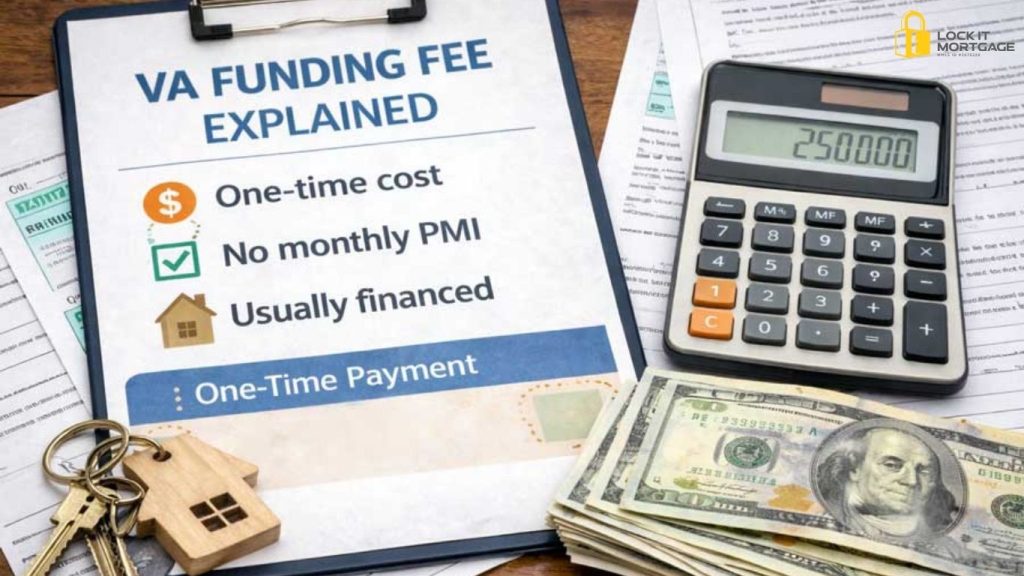
VA funding fee explained for 2026
The funding fee keeps the VA home loan program running so it stays available for future veterans and service members. Because of this, VA loan offers some of the best benefits on the market:
- Competitive interest rates: Typically lower than conventional & FHA loan options.
- No money down: Buy a home with as low as $0 down payment (depending on eligibility).
- No monthly private mortgage insurance (PMI): Save hundreds every month compared to other low-down-payment loans.
By paying this one-time fee, you help protect these exclusive advantages for the next generation of military families.
2. How much is the VA funding fee?
The VA funding fee is calculated as a percentage of your total loan amount, though the specific rate varies depending on your transaction type.
For home purchases, this mandatory cost typically ranges from 1.25% to 3.3%, while specialized options like an IRRRL refinance feature a much lower rate of only 0.5%. Conversely, a repeat borrower opting for a cash-out refinance may see this fee reach 3.3%.

VA funding fees vary depending on the type of loan and other factors.
Several key factors impact the total cost of your VA funding fee:
- Loan Purpose: Home purchase, streamline refinance (VA IRRRL), cash-out refinance.
- Down Payment: Contributing more equity upfront is one of the most effective ways to lower your mandatory expenses.
- Property Type: The specific type of home being financed, such as a manufactured home or a standard single-family residence, can affect the final calculation.
- Prior Use: Your rate is influenced by whether you are using your VA home loan benefits for the first time or as a subsequent user.
Some veterans are completely exempt from these upfront charges. Your eligibility for a 100% fee waiver is officially documented based on your service history and disability status.
Check your real-time rates and see a complete breakdown of your funding fee here.
3. Who is exempt from the VA funding fee?
Not all veterans are required to pay this administrative cost. You may qualify for a 100% exemption if you meet any of the following criteria:
- Service-Connected Disability: You receive VA compensation for a disability related to your service (typically a rating of 10% or higher).
- Retirement in Lieu of Compensation: You are entitled to disability compensation but receive retirement or active-duty pay instead.
- Surviving Spouses: You are the surviving spouse of a Veteran who died in active service or from a service-connected disability.
- Purple Heart Recipients: You are an active-duty service member who has been awarded the Purple Heart.
- Pre-Discharge Claim: You have a proposed or memorandum rating before your loan closing date that confirms eligibility for disability compensation.

VA funding fee exemptions apply to disabled veterans, eligible service members, and qualifying surviving spouses.
Your exempt status is typically confirmed on your Certificate of Eligibility (COE). This is the official document the lender uses to verify your service history and confirm if you qualify for a 100% fee waiver. Ensuring your COE accurately reflects your status is a critical step in avoiding unnecessary charges at closing.
4. VA funding fee chart 2026: Rates for purchase & refinance
As a member of the National Guard or Reserves, you pay the same VA funding fee rates as active-duty service members and Veterans. This alignment ensures your costs remain consistent across all branches of service.
Your specific fee is determined solely by your loan type, down payment, and whether you have used your home loan benefits in the past.
4.1. VA purchase funding fee table
| Loan type | Down payment | First-time use | Subsequent use |
| Purchase | 0% | 2.15% | 3.3% |
| Purchase | 5% or more | 1.5% | 1.5% |
| Purchase | 10% or more | 1.25% | 1.25% |
4.2. VA refinance funding fee table:
| VA Streamline Refinance (VA IRRRL) | N/A | 0.5% | 0.5% |
| Cash-out Refinance | N/A | 2.15% | 3.3% |
4.3. How to calculate your VA funding fee
The formula for calculating the VA funding fee is straightforward:
VA loan funding fee formula = Loan Amount x Applicable funding fee percentage
Example 1: If you are a first-time user purchasing a home with $0 down, your funding fee rate is 2.15%.
- Loan Amount: $300,000
- Funding Fee Rate: 2.15%
- Calculation: $300,000 x 0.0215 = $6,450
In this example, your total VA funding fee would be $6,450.
Example 2: If you are a subsequent user refinancing with a Cash-Out Refinance, your funding fee rate is 3.3%.
- Loan Amount: $250,000
- Funding Fee Rate: 3.3%
- Calculation: $250,000 x 0.033 = $8,250
In this example, your total VA funding fee would be $8,250.
4.4. 5 things every veteran should know
- You can “Finance” the Fee: Most veterans choose to roll this fee into their total loan amount so they don’t have to pay it in cash at closing.
- The “subsequent use” Jump: If you use the VA benefit a second time with $0 down, the fee increases to 3.30%. However, if you provide a down payment of at least 5%, the fee drops to 1.50% regardless of how many times you have used the program in the past.

VA funding fee options include financing, rate differences, and exemptions.
- Refinancing from other loan types: If you refinance from a non-VA loan (such as an FHA or Conventional loan) into a VA loan, it is categorized as a VA cash-out refinance. This means the standard purchase/refinance fee rates apply rather than the lower streamline rate
- Lower fees for VA Streamlines (IRRRL): These higher fees do not apply to the Interest Rate Reduction Refinance Loan (IRRRL). This specialized tool replaces an existing VA loan with a new one to lower your interest rate. For all IRRRLs, the funding fee is a flat 0.50%, no matter how many times you have used your entitlement.
- Check for Exempt Status: If you have a service-connected disability rating (even 10%), you likely qualify for a total exemption. This means you pay $0.00 in funding fees, which can save you thousands of dollars upfront.
5. Ways to pay your 2026 VA funding fee
The VA funding fee is due at the time of loan closing, not during the application or processing phase. You have several ways to handle this cost. You can pay the entire fee in cash on closing day, or you can choose to finance the fee by rolling it into your total loan amount.
- Most Veterans choose to finance the fee to eliminate the need for extra cash at closing. Financing the fee reduces your upfront costs but slightly increases your monthly payment and the total interest paid over the life of the loan.
- Negotiating for Seller Concessions: Another powerful option is to have a motivated home seller pay the fee for you. Under VA guidelines, sellers can contribute up to 4% of the home’s value toward “concessions,” which can include:
- Your full VA funding fee.
- Prepaid property taxes and insurance.
- Payment of existing credit balances or judgments.

The VA funding fee can be paid in cash at closing instead of being financed into the loan.
It is important to distinguish between seller concessions and standard closing costs. While the 4% cap applies to the funding fee and other concessions, there is no specific VA limit on how much a seller can pay toward your standard closing costs such as loan origination fees, appraisal fee, title fees,…
6. Accessing your VA loan benefits
To use your VA loan entitlement, you need a Certificate of Eligibility (COE). This official document verifies that you meet the service requirements necessary to access the benefit.
In 2026, obtaining your COE is a fast and straightforward process:
- Through your lender: This is the most efficient method. Most VA-approved lenders can pull your COE in minutes through the VA’s internal Web LGY system.
- Online: You can request the document yourself by logging into the VA eBenefits portal or VA.gov.
- By Mail: You can submit VA Form 26-1880 to your regional loan center. This is the slowest method and typically reserved for unique eligibility cases.
For a deeper look at eligibility and requirements, see our comprehensive VA loan 2026 guide.
7. How I qualify for a VA loan
A Certificate of Eligibility (COE) proves you have the right to use the VA benefits, but it does not guarantee loan approval. To secure a mortgage, you must still meet a lender’s specific underwriting requirements.
In 2026, VA lenders evaluate your application based on four primary factors:
- Credit History: While the VA does not set a minimum credit score, most lenders require a FICO score of 620 or higher. Some specialized lenders may consider scores as low as 580 if you have strong compensating factors like significant savings.
- Debt to Income (DTI) Ratio: Lenders prefer a DTI of 41% or less. However, the VA program is flexible; you can often exceed this limit if you have high residual income, which is the cash left over each month after all bills are paid.
- Stable Income: You must demonstrate reliable, predictable income—usually through two years of steady employment or verified benefit payments—to ensure you can handle the monthly mortgage.
- Property Standards: The home itself must pass a VA appraisal to ensure it is safe, sound, and sanitary.

A VA Certificate of Eligibility (COE) confirms eligibility but loan approval depends on credit, income, debt ratio, and property standards.
8. VA loan limits in 2026
If you have your full VA entitlement, the VA no longer sets maximum loan limits. This means you can technically borrow as much as a lender is willing to provide with $0 down, provided you meet their income and credit requirements.
However, if you are purchasing a high priced home, your lender may transition you into a VA Jumbo Loan. While these still offer $0 down options for those with full entitlement, they often come with stricter credit score requirements and may require more substantial cash reserves.
For 2026, the standard conforming loan limit in most of the country has increased to $832,750. If your loan exceeds this amount, it is typically classified as a jumbo loan, even if the VA does not require a down payment. In high-cost areas, this conforming limit can reach as high as $1,249,125.
9. What types of VA loans are available?
The VA loan program offers several flexible options for veterans, active-duty service members, and eligible surviving spouses, whether you’re buying, or refinancing a home.
Essential VA loan programs every borrower should understand before applying.
Here are the most common VA loan products:
- VA home purchase loans
- VA jumbo loans
- VA streamline refinance (IRRRL)
- VA cash-out refinance
- VA loan assumption
In conclusion, the VA funding fee is a vital component of the program. These pooled resources allow the Department of Veterans Affairs (VA) to guarantee loans with 0% down payments and no monthly private mortgage insurance (PMI). By contributing this one-time administrative fee, you help sustain these exclusive benefits for future generations of service members.
Understanding how these fees work allows you to make the most of your hard earned benefits. Whether you choose to pay the fee upfront, negotiate for seller concessions, or roll the cost into your loan, you have the flexibility to structure your mortgage in a way that fits your budget.
Whether you are exploring a VA first time home buyer program or looking to lower your rate with a VA streamline refinance (IRRRL), Lock It Mortgage is ready to help you secure the most competitive terms available.
Ready to make your move? Let us find the right home loan for you!
- Call us: 888-870-5625
- Email: info@lockitmtg.com