


Key Takeaways
- FHA loans require both a one-time upfront premium (UFMIP) and an ongoing annual premium (MIP) added to your monthly bills.
- FHA mortgage insurance is required regardless of your down payment amount.
- While it can be more expensive than PMI on a conventional loan, it provides a stable, predictable cost for those utilizing the FHA’s flexible qualifying rules.
- Premiums are determined by several factors, including your total loan amount & loan term.
What is an FHA mortgage insurance premium (MIP)?
FHA loans are government-backed mortgages insured by the Federal Housing Administration (FHA). Because these loans allow for lower credit scores and smaller down payments, FHA mortgage insurance is required to protect lenders against financial loss if a borrower defaults on their payments.
This insurance allows FHA-approved lenders to offer financing on several property types, including:
- Single-family homes
- Multifamily properties (2–4 units)
- Manufactured homes
- Condos and co-ops

FHA mortgage insurance explained
To maintain this protection, the FHA charges two distinct types of premiums:
- Upfront Mortgage Insurance Premium (UFMIP): A one-time fee paid at the time of closing.
- Annual Mortgage Insurance Premium (MIP): A recurring monthly fee integrated into your mortgage payment.
How does FHA mortgage insurance work?
FHA-approved lenders are required to disclose all FHA mortgage insurance costs on your Loan Estimate. While both the upfront and annual premiums are mandatory, they are handled differently within your mortgage structure.
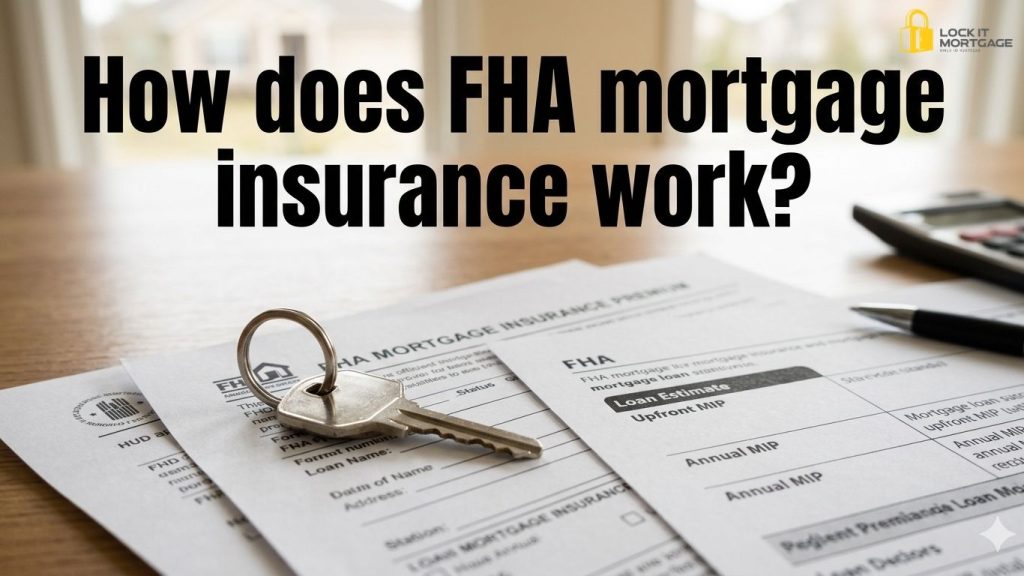
Explaining how FHA mortgage insurance works
Upfront Mortgage Insurance Premium (UFMIP)
- Charged as a lump sum equal to 1.75% of your base loan amount.
- Most borrowers finance this amount by rolling it into the total mortgage balance, though you can choose to pay it in full at closing. Partial cash payments are not permitted.
- This fee applies to all FHA borrowers regardless of credit score or down payment size.
- Generally non-refundable. However, if you refinance into a new FHA loan (FHA streamline refinance) within 36 months, you may be eligible for a partial credit toward your new upfront premium.
Annual Mortgage Insurance Premium (MIP)
- Like the upfront premium, your monthly MIP rate is the same regardless of your credit score.
- This premium is determined by your Loan-to-Value (LTV) ratio, your base loan amount, and your loan term (15 vs. 30 years).
- While called an “annual” premium, the cost is divided by 12 and added directly to your monthly mortgage payment.
- This premium is required even if you have significant equity; however, your down payment amount at closing determines how many years you will pay it.
FHA MIP vs. PMI: Key differences
Many buyers, especially those entering the market for the first time (FTHB), weigh the pros and cons of FHA loans versus conventional mortgages. The primary factor in this decision is often the cost and duration of mortgage insurance. While both protect the lender, they operate under very different rules.
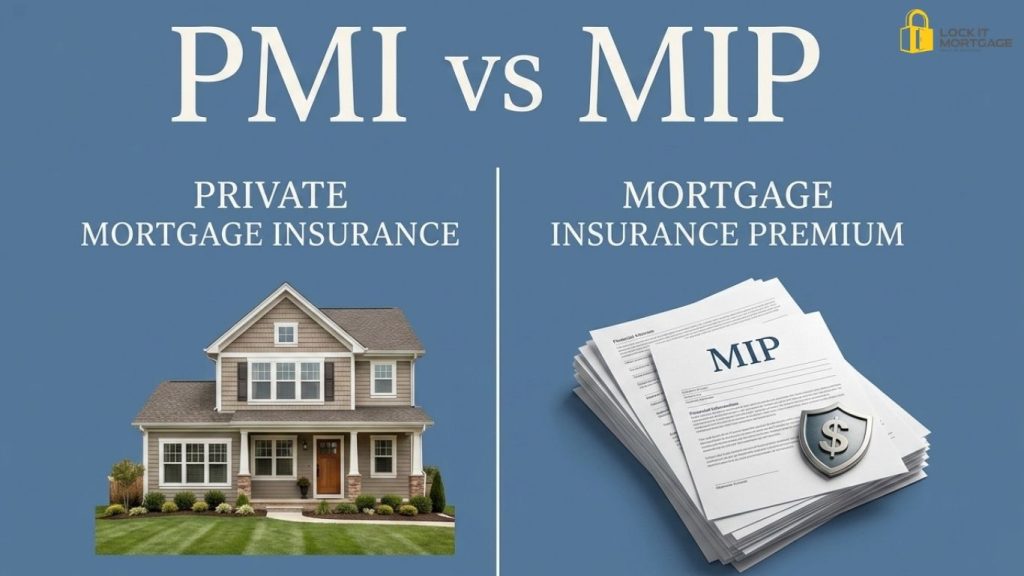
Comparison chart of PMI vs. MIP mortgage insurance requirements
| Feature | FHA Mortgage Insurance Premium (MIP) | Conventional Private Mortgage Insurance (PMI) |
| Credit score | None. Every borrower at the same LTV pays the same rate, regardless of credit score. | High Impact. Your monthly rate is determined by your credit score. Lower scores pay much more. |
| Down payment | Required for all borrowers, even if you put down 10% or 15%. | Not required if you provide a down payment of 20% or more. |
| Minimum Credit score | More flexible. Available for scores as low as 500. | Stricter. No minimum score set. Still, most lenders require a score of 620+ to qualify. |
| How to cancel | Usually stays for the life of the loan (if <10% down) or expires after 11 years (if >10% down). | Cancelable. Can be removed once you reach 20% equity in the home. |
The real cost of FHA mortgage insurance in 2026
The cost of FHA mortgage insurance is calculated based on two components: the one-time Upfront Premium and the Annual Premium. For 2026, these costs remain a competitive way to enter the market compared to the high PMI rates often associated with lower credit scores.
Upfront mortgage insurance premium (UFMIP)
The Upfront Premium is a one-time fee mandatory for all FHA borrowers. For 2026, the rate remains 1.75% of your base loan amount. You have two choices for how to handle this cost:
- Finance it (Most common): You roll the entire amount into your total mortgage balance. This keeps your out-of-pocket costs low but slightly increases your monthly payment and total interest paid over time.
- Pay in cash: You can pay the full 1.75% in cash at closing. This prevents your loan balance from increasing and keeps your monthly payments lower.
Note: FHA rules require an “all or nothing” approach. You must either finance the full amount or pay it all in cash.
If you refinance into a new FHA loan within 3 years (36 months), you may receive a partial credit of this fee toward your new loan.
Annual mortgage insurance premium (Annual MIP)
The annual MIP is what impacts your monthly budget. It ranges from 0.15% to 0.75%, depending on four key factors:
- Standard purchases and refinances share the same rates, but FHA streamline refinances may qualify for lower premiums.
- A larger down payment can reduce your rate and the number of years you pay it.
- 15-year mortgages offer significantly lower insurance rates than 30-year mortgages.
- FHA uses a “floor” and “ceiling” for loan limits. In 2026, the floor for a single-family home is $541,287, while high-cost areas go up to $1,249,125.
- Standard purchases and refinances share the same rates, but FHA streamline refinances may qualify for lower premiums.

2026 FHA Annual MIP rates and factors affecting monthly mortgage insurance costs
FHA MIP for mortgage term of more than 15 years (Standard 30-Year Fixed Mortgages)
| Base loan amount | Loan-to-Value (LTV) | Annual MIP | Duration of Payment |
| $726,200 or less | ≤90% | 0.50% | 11 years |
| > 90% (Min. 3.5% Down) | 0.55% | Life of Loan | |
| Above $726,200 | ≤ 90% | 0.70% | 11 years |
| > 90% | 0.75% | Life of Loan |
*Applies to all purchases and refinances except FHA streamlines, Hawaiian Home Lands loans, and certain legacy FHA loans closed on or before May 31, 2009.
FHA MIP for mortgage term of 15 years or less
For buyers looking to build equity faster, shorter-term FHA loans offer significantly reduced insurance rates.
| Base loan amount | Loan-to-Value (LTV) | Annual MIP | Duration of Payment |
| $726,200 or less | ≤90% | 0.15% | 11 years |
| >90% | 0.40% | Life of Loan | |
| Above $726,200 | ≤78% | 0.15% | 11 years |
| >78% but ≤ 90% | 0.40% | 11 years | |
| >90% | 0.65% | Life of Loan |
*Applies to all purchases and refinances except FHA streamlines, Hawaiian Home Lands loans, and certain legacy FHA loans closed on or before May 31, 2009.
FHA simple or streamline refinances
If you already have an FHA loan and are looking to lower your rate, the streamline refinance has its own simplified insurance structure.
| Base loan amount | Loan-to-Value (LTV) | Annual MIP | Duration of Payment |
| Any | ≤90% | 0.55% | 11 years |
| Any | >90% | 0.55% | Life of Loan |
*These specific premium rates apply to FHA streamline refinances. If your original FHA loan was closed on or before May 31, 2009, you may be eligible for even lower rates.
Practical example you can follow
To help you see exactly how these numbers work, let’s look at a standard $400,000 purchase. In this scenario, we’ll see how the monthly FHA mortgage insurance is built from the ground up.
The loan scenario:
- Purchase Price: $414,508
- Down Payment (3.5%): ~ $14,508
- Base Loan Amount: ~ $400,000
Step 1. Calculating the one-time upfront fee
The FHA charges a mandatory upfront fee of 1.75% of your base loan.
- Upfront MIP = $400,000 * 1.75% = $7,000
Step 2. Calculating the standard monthly insurance
Next, we calculate the annual insurance (0.55%) and divide it by 12 to find your base monthly cost.
- Monthly MIP = ($400,000 * 0.55%) / 12 months = $183.33
Step 3. Rolling the fee into the loan
Instead of paying the $7,000 upfront MIP fee in cash at closing, most buyers choose to roll it to their total loan. This creates a new loan amount of $407,000. Because that $7,000 is now part of your mortgage, you pay it back with interest over 30 years (360 payments).
- $7,000 financed at current FHA mortgage rate of ~6.125% (6.148% APR) – Rate as of 04/28/2026.
The result: This adds approximately $43.00 to your monthly payment.
Step 4. The total monthly mortgage insurance
To find your total monthly insurance payment, we simply add the standard insurance to the cost of financing the upfront fee.
- Total monthly insurance payment: $183.33 (Standard) + $43.00 (Monthly Financing Cost) = $226.33
How to avoid or remove FHA mortgage insurance
While FHA mortgage insurance is a requirement for the loan, it doesn’t have to be a permanent part of your financial life. Here is how you can minimize or eventually eliminate these costs.
Choose a different loan type
If your credit score and down payment allow for it, you might avoid FHA-specific premiums by looking at these alternatives:
- Conventional Loans: These do not have a mandatory upfront fee. If you put down 20% or more, you avoid monthly mortgage insurance (PMI) entirely. If you put down less than 20%, you will still pay PMI, but it is often cheaper than FHA insurance if you have a high credit score.
- VA Loans: Reserved for military members, veterans, or surviving spouses. These loans require $0 down and have no monthly mortgage insurance. There is a one-time “Funding Fee” (1.25% to 3.30%), but this can be financed into the loan.
- USDA Loans: Available for homes in designated rural areas. Instead of MIP, you pay a 1% upfront guarantee fee and an annual fee of 0.35%. This is often the most affordable “no-down-payment” option if you qualify for the location.

Explore loan alternatives to avoid or remove FHA mortgage insurance
The “11-year rule”: Save for a bigger down payment
Increasing your down payment won’t eliminate the upfront fee, but it can dramatically change the timeline for your monthly payments.
- The 10% strategy: If you put down at least 10%, your monthly mortgage insurance (MIP) will automatically expire after 11 years.
- The 3.5% reality: If you put down less than 10%, you are technically required to pay MIP for the life of the loan (the full 30 years).
Strategy Note: Don’t let the “Life of the Loan” rule scare you. Most entrance homebuyers do not stay in their first FHA loan for 30 years. They typically refinance into a Conventional loan once their home value increases or their loan balance drops.
Refinance out of the FHA loan
This is the most common way to “cancel” FHA insurance. Once you have built 20% equity in your home (through a combination of making payments and your home’s value increasing), you can refinance into a Conventional Loan.
Since you now have 20% equity, the Conventional loan will not require any mortgage insurance at all. This is the ultimate goal for most FHA borrowers, using the FHA loan as the “key” to the front door, then switching to a lower-cost loan once they are established.
While FHA mortgage insurance is an added cost, it provides specific benefits that often outweigh the monthly fee for 2026 buyers:
- Better rates: FHA loans often come with lower interest rates than conventional loans, which can offset the cost of the insurance premium.
- More buying power: FHA guidelines allow for a higher debt-to-income ratio, meaning you can qualify for more home than you might otherwise.
- Low entry barrier: You can stop renting and start building equity with as little as 3.5% down, even if your credit isn’t perfect.
Think of an FHA loan as Phase One. It gets you into the home now, helps you build credit, and allows you to start growing your net worth. When you’ve reached that 20% equity milestone, we’ll move to Phase Two: refinancing you into a conventional loan and dropping that insurance for good.
At Lock It Mortgage, we’re here to help you find that perfect entry point where the numbers make sense and your savings stay protected.
Ready to see what’s possible? Let’s connect today to look at your options and get you moving.
- Call us: 888-870-5625
- Email us: info@lockitmtg.com