


Key Takeaways:
- FHA loans make it simpler to buy a home by offering flexible qualifying rules, including low down payment, flexible income and debt requirements.
- FHA programs offer more than just home buying solutions, refinance options, renovation loans, and specialty financing designed to fit your financial goals.
- Although FHA loans require mortgage insurance for the life of the loan, most borrowers accept this cost in exchange for lower down payments and flexible credit requirements.
For decades, the FHA loan program has helped people become homeowners by offering flexible credit rules. If you qualify, you can buy a house with a 580 credit score and a low down payment of just 3.5%.
FHA benefits aren’t just for buyers. Current homeowners can use an FHA refinance to lower interest rates or access home equity without needing perfect credit.
What is an FHA loan?
FHA loans are government-backed mortgages insured by the Federal Housing Administration (FHA). Because they offer flexible qualifying guidelines and competitive interest rates, FHA loan is one of the top choices for many first-time home buyers, borrowers with low-to-moderate incomes and those working to improve their credit scores.
FHA mortgage insurance allows lenders to expand homeownership opportunities to all eligible borrowers. Because the FHA insurance protects mortgage lenders, this allows them to offer competitive mortgage rates, flexible credit standards, and a minimum down payment of just 3.5%.
Are FHA loans a good choice for first-time homebuyers?
How does an FHA loan work?
The most important thing to understand is that the Federal Housing Administration (FHA) does not actually lend you the money. Instead, you receive your mortgage from an FHA-approved bank or lender, much like you would with any other home loan.
The FHA’s true role is to insure these mortgages. By providing this government backing, the FHA protects lenders against potential losses if a borrower is unable to make payments. This added security gives mortgage lenders the confidence to offer more inclusive terms, including lower interest rates and flexible credit score requirements.
To keep this program accessible for all homebuyers, the FHA loan requires borrowers to pay for the insurance that protects the lender. This is also known as the Mortgage Insurance Premium (MIP). This insurance typically stays for the life of the loan. However, we will later discuss several strategic ways to manage, prevent, or eventually remove this cost.
For a detailed breakdown of these expenses, see our guide on how FHA mortgage insurance works and what it costs in 2026.
Key benefits of an FHA loan for 2026 homebuyers
FHA loans are popular among first-time home buyers (FTHB) because they prioritize accessibility over strict requirements. Whether you prefer fixed-rate stability or initial ARM savings, this program fits your budget.
Here are the primary benefits that make FHA financing a standout option in 2026:
- Purchase your home with as little as 3.5% down.
- Qualify with a debt-to-income (DTI) ratio as high as 43% to 50% when meeting specific compensating factors.
- Qualify with a 580+ score for the minimum 3.5% down payment or as low as 500–579 with a 10% down payment.
- Qualify even without a traditional credit score. HUD guidelines prohibit lenders from denying your application solely for a lack of credit history.
- Use non-traditional credit sources such as documented rent and utility payments to prove your financial reliability.
- Utilize gift funds from family or approved sources to cover your entire down payment and closing costs.
- Take advantage of 2026 FHA loan limits starting at $541,287 in standard markets and reaching up to $1,249,125 in high-cost areas.
- Potentially lower your mortgage rate with minimal documentation & no appraisal through an FHA streamline refinance.
Benefits of FHA loans for homebuyers
Check your real-time FHA mortgage rates





LOAN LIMITS
SEND US YOUR QUESTION(S)
SHARE THIS RATE QUOTE
OUR LOAN OFFICERS ARE HERE TO HELP!
Fill out the form below, and we'll be in touch shortly.
VA FUNDING FEE RATES
VA IRRRL FUNDING FEE RATES
PROPOSED Housing EXPENSE
RATE ALERT SETUP
Common types of FHA loans in 2026
The FHA program isn’t a “one-size-fits-all” mortgage. Depending on the type of property you are looking for and your long-term plans, there is likely an FHA option designed to help you get there.
The standard home purchase (203b)
This is the most popular FHA loan. It is used for buying a primary residence that is already in good condition. This can be a single-family house, a townhome, or even a multi-unit property (up to 4 units) as long as you live in one of them.
- Down payment: As low as 3.5% down.
- Credit score: You only need a 580 score to qualify for the low down payment, though scores as low as 500 may be accepted with a 10% down payment.
Renovation loans
For buyers looking to improve their property, FHA renovation loans offer the perfect solution. This flexible option combines your home purchase and upgrade costs into one convenient mortgage:
- FHA 203(k) Rehabilitation loan: If you’re purchasing a home that needs work, this program lets you roll the purchase price and renovation costs into one loan. It’s a practical solution for turning a fixer-upper into your dream home without needing a separate high-interest construction loan.
- FHA Energy Efficient Mortgage (EEM): This loan allows you to finance eco-friendly upgrades, like solar panels, modern HVAC, or insulation as part of your FHA mortgage. This reduces your monthly utility costs while instantly increasing your home’s value.
- Benefit: You can often exceed standard loan limits to cover the cost of these energy-saving improvements.
- FHA Title 1 Property Improvement loan: Perfect for smaller-scale repairs, this allows you to finance upgrades without refinancing your existing mortgage. It’s a flexible way to make your current home more functional or energy-efficient.
- Ideal for: Homeowners who already have a great rate on their first mortgage but need cash for specific improvements.
Specialty FHA programs for unique needs
The FHA also offers several niche programs built to specific financial situations or property types.
- FHA construction-to-permanent loan: This simplifies building your dream home by combining the land purchase, construction costs, and the final mortgage into one single closing. Once you finish construction, the loan automatically becomes a permanent mortgage.
- FHA manufactured home loans (Title II): Specifically for purchasing or refinancing manufactured homes, this program ensures affordability for non-traditional properties that meet FHA standards.
- Section 245(a) loan (graduated payment mortgage): Expecting your income to grow in the coming years? This option starts with lower monthly payments that gradually increase over time. It is a strategic fit for young professionals or those with anticipated career advancements.
- FHA home equity conversion mortgage (HECM): A reverse mortgage designed for homeowners aged 62 and older. This allows you to access your home’s equity as cash without selling the property or making monthly mortgage payments.
- The maximum claim amount for HECMs has increased to $1,249,125.
FHA refinance options
Even after you’ve settled into your home, the FHA program offers several ways to improve your financial position. Refinancing can lower your payments or provide cash for home improvements. To help you succeed, we customize these strategies within the mortgage program we offer to match your long-term goals.
- FHA streamline refinance: This is the most popular choice for current FHA homeowners. It is designed to be fast and cost-effective by removing many of the usual refinancing hurdles.
- The benefit: Potentially lower your interest rate with no new appraisal and minimal documentation.
- Key requirement: You must already have an FHA loan and have a history of on-time payments for the last six months.
- Pro-tip: This is ideal if your home’s value has dipped or if you simply want a lower payment without a lot of paperwork.
- FHA rate-and-term refinance: This “simple” refinance is a middle ground between the streamline and a full refinance. It allows you to move from one FHA loan to another to change your loan terms (like moving from an Adjustable Rate to a Fixed Rate).
- The benefit: It offers more flexibility in changing your loan structure than the Streamline, though it typically requires a new appraisal.
- Key requirement: It must result in a “net tangible benefit,“ meaning the new loan must actually put you in a better financial position.
- FHA cash-out refinance: If your home has increased in value, a cash-out refinance allows you to replace your current mortgage with a larger one and take the difference in cash.
- The benefit: Use the cash for debt consolidation, major home repairs, or other large expenses.
- Key requirement: You can borrow up to 80% of your home’s appraised value. Unlike the Streamline, this does require a full appraisal and credit check.
- Flexibility: You don’t need to have an FHA loan currently to use this; you can refinance from a conventional loan into an FHA cash-out.
- FHA 203(k) refinance: If you love your home but want to modernize it, the 203(k) refinance lets you pay off your existing mortgage and add the cost of repairs into one single loan.
The mortgage insurance premium (MIP) of a FHA loan:
To take advantage of the FHA’s flexible standards, you’ll want to factor the Mortgage Insurance Premium (MIP) into your math. In 2026, this breaks down into two specific parts:
- Upfront mortgage insurance premium (UFMIP): This is a one-time fee equal to 1.75% of your base loan amount. Most homebuyers roll this cost into their mortgage balance at closing to avoid paying cash upfront.
- Annual mortgage insurance premium (Annual MIP): This is an ongoing fee that is divided by 12 and added to your monthly mortgage payment. For most 2026 borrowers, this rate is approximately 0.55% of the loan balance.

FHA mortgage insurance for 2026
Depending on your down payment, this insurance typically remains for the life of the loan or until you reach 11 years of payments (with a 10% down payment). Many homeowners eventually choose to perform an FHA to conventional refinance to remove this monthly cost once they have built sufficient equity.
General FHA loan requirements for 2026
While the FHA program offers flexibility, every borrower must meet specific standards. Understanding these “Big Four” requirements early in the process will help you prepare for a successful application.
- Credit score and down payment: Your credit score directly determines how much you need to contribute for a down payment.
- 580 or higher: You qualify for the minimum down payment of 3.5%.
- 500 to 579: You can still qualify, but you must provide a 10% down payment.
- No credit history: If you don’t have a traditional score, we can often use “alternative credit” like utility bills or rent history to prove your reliability.

Credit score requirements for FHA loans 2026
- Debt to income (DTI) ratio: Lenders look at your DTI to ensure you can comfortably manage your new mortgage along with your existing monthly debts.
- Most lenders look for a DTI of 43% or lower.
- With “compensating factors” such as significant savings or a high credit score, it is possible to qualify with a DTI as high as 50%.
- Employment and income stability: You don’t need to be at the same job for decades, but you do need to show consistent income.
- Lenders typically want to see a steady two year work history.
- You’ll provide recent pay stubs, W2s, and tax returns to verify your earnings.
- If you are self-employed, you’ll generally need two years of tax returns to establish your average income.
- Property standards (The FHA Appraisal): Because the FHA insures the loan, the home itself must meet “Minimum Property Standards” for safety and habitability. An FHA approved appraiser will check for:
- A solid foundation and a roof that will last at least another two years.
- Heating, plumbing, and electrical systems.
- Health no lead based peeling paint for homes built before 1978 or active pest infestations.
Important borrower checklist: Beyond the numbers, you must keep these three essential rules in mind:
- Federal Debt: You cannot have any delinquent federal debt such as unpaid taxes or defaulted student loans.
- Primary Residence: You must intend to live in the home as your main residence. You can’t use FHA loans for investment properties or second homes.
- Occupancy: You are required to move into the home within 60 days of closing.
FHA loans vs. Conventional loans: Which is better?
Choosing the right mortgage depends on whether you prioritize immediate accessibility or long-term savings. An FHA loan is a powerful tool for bridging the gap to homeownership today, offering a premier choice for those who want to get into a home sooner with flexible requirements. Conventional loans provide superior long-term savings and flexibility. However, they require stricter qualifying standards, including higher credit scores and larger down payments.
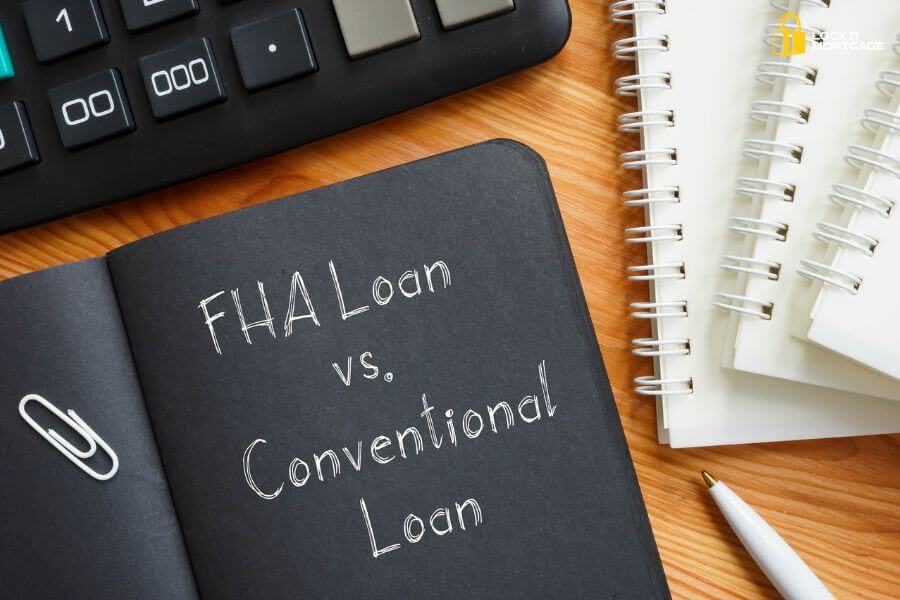
FHA loan vs Conventional loan comparision
Here is a breakdown of the key differences for 2026:
| Feature | FHA loan | Conventional loan |
| Best for | Buyers with a lower credit score, higher debt-to-income (DTI) ratio, or minimal savings. | Buyers with good credit, a solid financial history, and steady income. |
| Credit score | 500 – 579 (with 10% down) or 580+ (with 3.5% down) | No minimum score (620+ preferred) |
| Minimum down payment | As low as 3.5% (Depending on eligibility) | As low as 3% (for qualified buyers) |
| Mortgage insurance | Upfront MIP required (1.75% of loan amount). Annual MIP will remain for the life of the loan if the down payment is under 10%. | PMI is cancelable once you reach 20% equity (a massive long-term saving). |
| DTI ratio | Flexible, up to 50% in some certain cases. | Stricter, typically 43% – 45%. |
| Standard loan limits | 1-Unit: $541,287 (Baseline) 2-Units: $693,050 3-Units: $837,700 4-Units: $1,041,125 | 1-Unit: $832,750 (Baseline) 2-Units: $1,066,250 3-Units: $1,288,800 4-Units: $1,601,750 |
The FHA loan remains one of the most powerful options available, especially for first-time homebuyers or those looking to optimize an existing loan. By eliminating the requirement for a “perfect” credit score and offering flexible qualifying guidelines, this program makes homeownership accessible much sooner than many realize. Once you see how the FHA program really works, you’ll realize it is more than just a way to buy a house. It is a smart first step that sets you up for bigger financial moves down the road. It acts as a flexible foundation for your future, designed to grow and change right along with you.
At Lock It Mortgage, we don’t just “give” loans; we help you structure them. We take the time to understand the whole picture of your credit, your savings, and your long-term goals, so we can find the perfect balance between a comfortable monthly payment and your total long-term savings. We treat your mortgage with the same care we would our own, ensuring you feel confident and supported at every step.
To keep things simple, we provide two easy ways for you to get started:
Ready to make your move? Let us help you find the right mortgage.
- Call us: 888-870-5625
- Email us: info@lockitmtg.com